Maker’s notebook · 5 min read
A mid-century dollhouse living room: furniture, layout and colour
Choose an anchor among real mid-century miniature files, keep their low band of heights and visible floor, and connect one wood tone with the wall colour.
Updated
The mid-century pieces in our collection are recognisable by their outlines before their colours: low, long shapes on slim legs, with floor showing beneath them. In a dollhouse, where the room is seen from one side and from close up, those outlines are what you need to protect.
The elevation above lines up five of these pieces at 1:12. For where they stand on the floor, our guide to draw the room layout places four of them in a measured plan and explains the gaps. We do not repeat that here. This guide is about what stands on those footprints: which piece to start from, how the heights relate and how to connect wood tone, upholstery and wall.
Choose an anchor piece
On 29 September 2026 our mid-century collection holds 18 released pieces, including kitchen and bathroom furniture. The seven below are the ones we would draw from for a living room. The dimensions are those of the supplied 1:12 files, the same measured figures as on each piece page.
| Piece | At 1:12 (W × D × H) | Supplied scales |
|---|---|---|
| Mid-Century Walnut Sofa | 175.0 × 68.6 × 65.3 mm | 1:12, 1:24, 1:6 |
| Scandinavian Oak Sofa | 166.7 × 62.0 × 63.0 mm | 1:12, 1:24, 1:6 |
| Mid-Century Lounge Chair | 65.6 × 70.8 × 65.9 mm | 1:12, 1:24, 1:6 |
| Mid-Century Kidney Coffee Table | 100.0 × 50.9 × 29.8 mm | 1:12, 1:24 |
| Scandinavian Round Coffee Table | 75.0 × 75.0 × 33.9 mm | 1:12, 1:24, 1:6 |
| Mid-Century Credenza | 150.0 × 38.4 × 65.9 mm | 1:12 |
| Mid-Century Architectural Library Bookcase | 106.5 × 32.5 × 166.7 mm | 1:12, 1:24 |
Start from the piece whose outline you most want seen. The walnut sofa is the largest and has a visible wooden frame around a button-tufted back and slim cushions, on angled legs. The credenza is the most decorated: four door fronts in a chevron relief, small pulls and an angled leg base. The lounge chair is the simplest shape, a single bent-plywood seat and back on four splayed legs.
Each of those shapes has a period reference you can look at. The V&A’s record of the Eames LCW lounge chair, dated 1945–1946, explains that it came from Charles and Ray Eames’s wartime experiments with moulding plywood. The V&A’s Finn Juhl FJ 45 armchair, shown in Copenhagen in 1945, has a teak frame carrying an upholstered seat and back, with open sides. Our pieces are original designs, not copies of either; the records are useful for seeing how wood, upholstery and open space work together at full size.
The scale you build at narrows the choice. At 1:24 every piece in the table is supplied except the credenza. At 1:6 only four are: both sofas, the lounge chair and the round coffee table.
Balance height and empty space
The main pieces share almost the same height, as the elevation shows. At 1:12 the walnut sofa is 65.3 mm tall, and the lounge chair and the credenza 65.9 mm each. The kidney table, at 29.8 mm, is less than half that. Together they form one low band across the room, with a lot of wall above it. That band is the look: resist adding tall pieces until you have seen it. The same band can take a piece from another collection: our guide to mix furniture styles around one shared height sets the lounge chair beside a Victorian sideboard 3.0 mm taller.
Designmuseum Danmark presents Danish Modern as a reaction against crowded living rooms full of heavy furniture, velvet curtains, carpets, plants and knick-knacks. For a miniature room, the practical lesson is to keep floor visible. Every piece in the plan stands on legs rather than on a solid base, so the floor continues underneath it. A contrasting floor colour, or light reaching under the sofa, makes that gap readable from the open front.
One tall piece can work if it is placed deliberately. The bookcase is 166.7 mm tall at 1:12, more than twice the height of the sofa. Against a side wall or in a back corner it frames the low group; in the centre of the back wall it would become the anchor instead.
Swapping pieces changes the space as well as the style. The round coffee table is 24.1 mm deeper than the kidney table. With the same 37.5 mm gap in front of the sofa, the clear foreground in that planning-guide layout drops from about 97 mm to about 73 mm. The oak sofa is 8.3 mm narrower and 6.7 mm shallower than the walnut one, so it gives a little of that space back.
Connect finish and wall colour
The files are supplied unpainted. Wood names in the titles, such as walnut and oak, describe the design direction; the finish is your decision. Choose one wood tone as the constant and use it on every visible frame, leg and top. A dark walnut tone suits the walnut sofa and the credenza. A pale oak tone suits the Scandinavian sofa and round table. Mixing the two in one small room splits the low band into separate objects.
Then pick one upholstery colour and at most one accent. The design leaves small metal details you can use: the credenza has pulls and the kidney table has ferrules at the feet of its legs. Painting both in the same metallic tone repeats a small accent across the room without adding an object. The painting guide explains how to plan thin coats and a restrained palette.
The wall is the largest surface above the low band, so choose it last and against the furniture. A plain wall shows the outlines most clearly. A pattern should be judged at the height of that band: a small repeat reads as texture behind a 65 mm sofa, while a repeat approaching the sofa’s height becomes a second feature. Hold a sample behind the painted pieces and print a test strip at the right size before papering the whole wall. Our own printable wallpapers are sold as digital downloads on Etsy.
For the wider choice between room directions, see dollhouse interior styles.
Common questions
Walnut or oak for a mid-century dollhouse room?
Either, but choose one as the main wood. Our collection includes both directions: the walnut sofa and credenza, and the lighter Scandinavian oak sofa and round table. The files are supplied unpainted, so the choice is made with paint.
Can I build this living room at 1:24?
Mostly. Both sofas, the lounge chair, both coffee tables and the bookcase are supplied at 1:24, but the credenza is supplied at 1:12 only. At 1:24 the low storage piece has to come from elsewhere.
Are these pieces copies of famous mid-century designs?
No. They are original designs in a mid-century direction. For period references, look at dated museum records such as the ones linked in this guide.
From the cabinet
Try it with a real design.
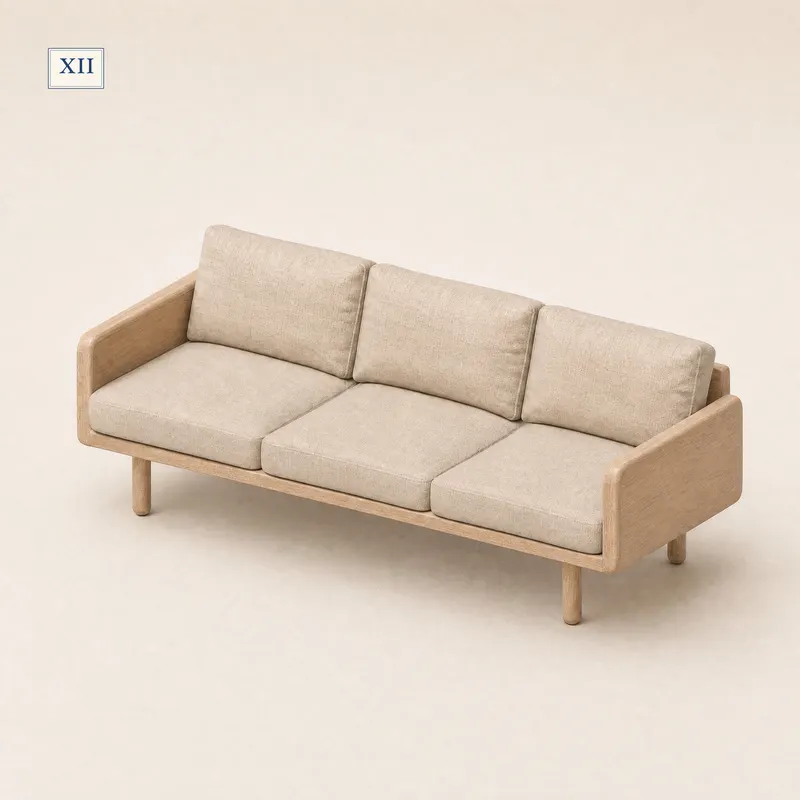
Scandinavian Oak Sofa
A lighter-wood alternative to the walnut sofa in the plan: 8.3 mm narrower and 6.7 mm shallower at 1:12, and supplied at 1:24 and 1:6 as well.
- 1:12
- 166.7 × 62.0 × 63.0 mm
- 1:24
- 83.3 × 31.0 × 31.5 mm
- 1:6
- 333.3 × 123.9 × 126.1 mm
Dimensions of the supplied files: width × depth × height. Room scenes illustrate the design; they are not physical print test records.
Check this piece’s details and sizes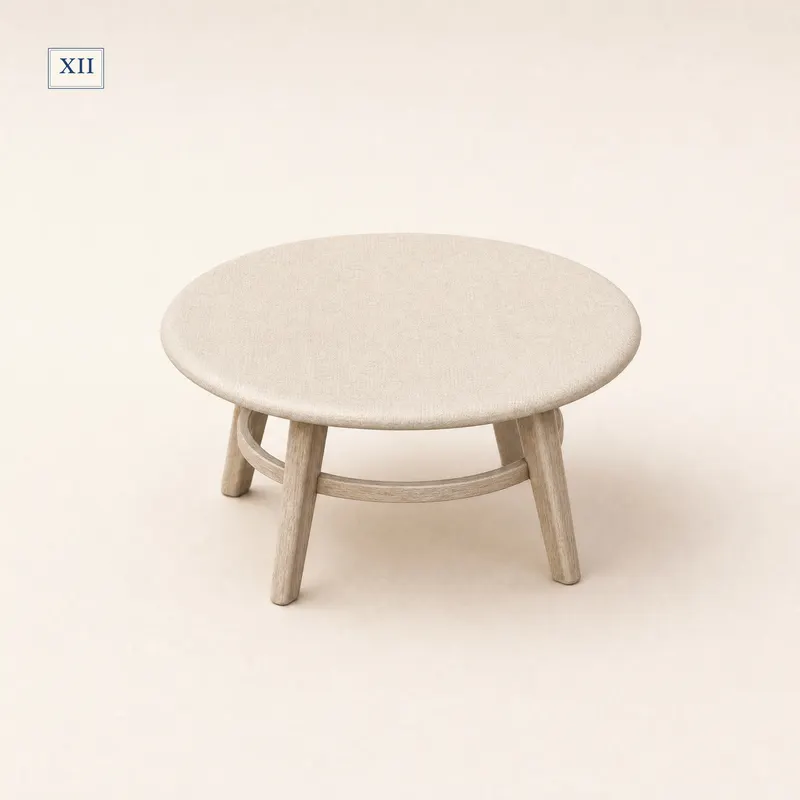
Scandinavian Round Coffee Table
A round alternative to the kidney table: 24.1 mm deeper at 1:12, so it shortens the clear foreground. It stands on three splayed legs, which keeps floor visible beneath it.
- 1:12
- 75.0 × 75.0 × 33.9 mm
- 1:24
- 37.5 × 37.5 × 17.0 mm
- 1:6
- 150.0 × 150.0 × 67.8 mm
Dimensions of the supplied files: width × depth × height. Room scenes illustrate the design; they are not physical print test records.
Check this piece’s details and sizes