Maker’s notebook · 5 min read
Dollhouse scale calculator: mm, inches and resizing percentages
Convert a full-size measurement to 1:6, 1:12, 1:24 or 1:48, find the slicer percentage between two scales, and estimate the scale of an unlabelled model.
Updated
Scale calculator
Work it out for your own piece.
Type a measurement; results update as you go. All three tools calculate in millimetres and use 1 inch = 25.4 mm. Round the result only when you measure.
A calculation describes size only. It cannot tell you whether a resized model keeps printable walls, joints or clearances — check the sliced layers.
The calculator above does three separate jobs. Use the first when you have a full-size measurement and need its miniature equivalent. Use the second when a file already exists at one scale and you want it at another. Use the third when you have a model but no reliable label.
Each result shows the arithmetic beneath it, so you can check the figure yourself or repeat it on paper. Nothing is stored or sent anywhere: the calculation happens in your browser.
Full size to miniature
Divide every full-size dimension by the scale’s denominator. At 1:12, a 1,800 mm table becomes 150 mm wide; at 1:24 it becomes 75 mm; at 1:48, 37.5 mm. The dollhouse scale chart explains why a larger denominator gives a smaller miniature, and lists common values if you prefer a table.
Keep the unit consistent on both sides of the calculation. The tool converts everything to millimetres first, using the exact definition 1 inch = 25.4 mm, then shows the result in both units. A 72-inch reference is therefore 1,828.8 mm full size and 152.4 mm at 1:12, not 150 mm. The difference is small on one table and noticeable across a run of cabinets.
The ruler figure rounds to the nearest sixteenth of an inch. Use it to mark a line or cut a paper template. When you type the value into a slicer or a drawing program, use the decimal millimetre figure instead; it has not been rounded to fit a ruler.
A catalogue example: the Mid-Century Rectangular Dining Table is supplied 150 mm wide at 1:12, which is the width our worked example predicts for a 1,800 mm table. Its supplied depth and height are measured from the file, so compare those on the piece page rather than assuming every proportion follows the full-size brief.
Resize a file to another scale
A file that is already a miniature must not be divided again. Use the ratio between its current and target denominators: old ÷ new × 100. A 1:12 file becomes 1:24 at 50%, and a 1:24 file becomes 1:12 at 200%.
Enter the width your slicer reports after import and the tool gives the width you should see once the percentage is applied. If the new figure does not appear in the slicer’s dimension panel, stop and check whether the file was imported in the expected unit. A model that arrives 25.4 times too large or too small usually has an inch/millimetre mismatch rather than a scale problem.
Keep scaling uniform. Changing one axis turns the piece into a different design: a round tabletop becomes oval, legs thicken in one direction only, and parts that should meet no longer line up.
Estimate the scale of a model
Measure one feature on the model and the same feature on a full-size reference. The tool divides the two and reports the nearest of the four common dollhouse scales. A 150 mm miniature of an 1,800 mm table gives exactly 1:12.
Choose a reference whose full-size dimension you actually know: a manufacturer’s stated table width, a standard door you have measured, or a doll whose height is printed on its box. Estimated references give estimated scales. If the result is more than 5% away from 1:6, 1:12, 1:24 or 1:48, the tool says so. The 5% threshold is simply our warning level, chosen because real furniture varies; it is not a published standard. Re-measure, try a second feature, then decide whether the model follows a less common ratio. For a whole dollhouse rather than a single model, identify the dollhouse’s scale from several features and keep only the ratios they all allow.
Use the numbers in a room
A conversion is only the first step. Mark the result as a rectangle on a floor plan and check it against the pieces already in the room. Our dollhouse room planning guide shows a complete 1:12 layout with measured gaps between four pieces, which is where a single dimension turns into a decision.
The same arithmetic applies to wallpaper. A pattern that repeats every 32 cm on a full-size wall should repeat every 26.67 mm at 1:12 and every 13.33 mm at 1:24. Type 32 cm into the first tool to check a printed test sheet against a real wallpaper you are imitating.
For furniture, compare two or three measurements rather than one. A chair can match a table’s scale on paper and still look wrong if its seat height leaves no room beneath the tabletop. The dollhouse furniture dimensions cheat sheet lists the relationships worth checking.
What the calculator cannot tell you
The calculator works on lengths. It cannot inspect a model’s geometry, so it does not know whether a resized leg is still thick enough to print, whether a hinge pin will still fit its socket, or whether a thin decorative edge will survive support removal. Halving a file halves every wall, gap and joint.
Treat a result as a size target, then open the file in your slicer and look at the layer preview. The guide to 3D printing dollhouse furniture covers that inspection step. When the designer supplies a file at your scale, prefer it: a dedicated file may have been checked or adjusted at that size, while a percentage in a slicer is an untested variant.
Common questions
How do I convert inches to 1:12 scale?
Divide the full-size measurement by twelve, keeping the same unit. A 72-inch table becomes 6 inches, which is 152.4 mm. At 1:12, one full-size foot becomes one inch.
What percentage prints a 1:12 file at 1:24?
50%, applied uniformly to all three axes. The rule is old denominator ÷ new denominator × 100, so 1:24 to 1:12 is 200% and 1:12 to 1:48 is 25%.
Can I use the calculator for 1:16 or 1:18?
Yes. Choose “Other ratio” in the first tool and type the denominator, for example 16. The resizing tool is limited to the four scales most dollhouse files are sold in.
From the cabinet
Try it with a real design.
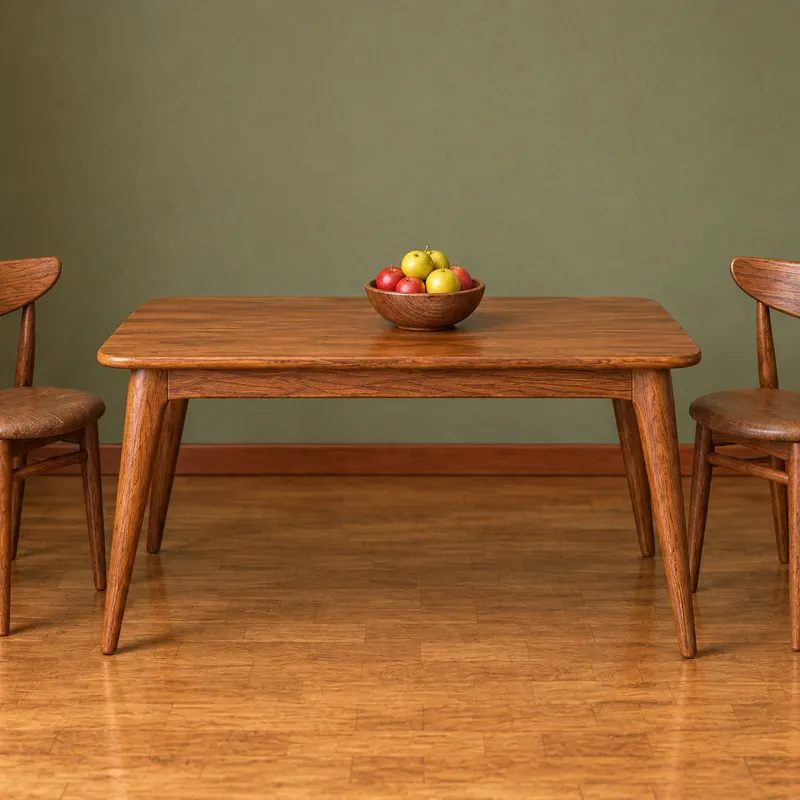
Mid-Century Rectangular Dining Table
Its supplied 1:12 file is 150 mm wide, the width the calculator gives for a 1,800 mm table. Compare the depth and height too: they are measured from the file.
- 1:12
- 150.0 × 74.3 × 48.5 mm
- 1:24
- 75.0 × 37.2 × 24.3 mm
Dimensions of the supplied files: width × depth × height. Room scenes illustrate the design; they are not physical print test records.
Check this piece’s details and sizes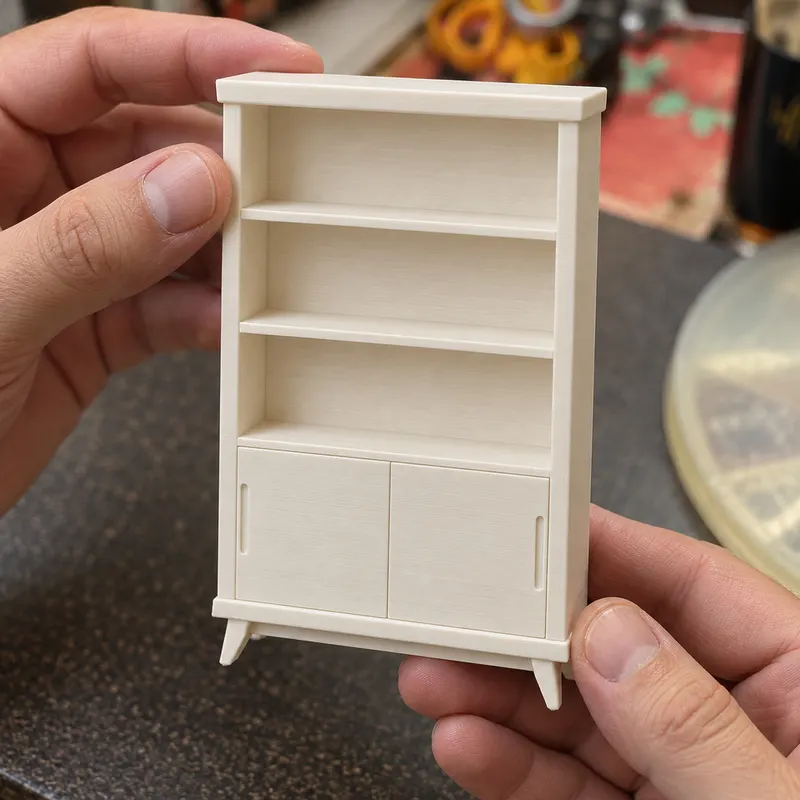
Mid-Century Architectural Library Bookcase
Enter a ceiling height in the first tool, then compare it with this bookcase’s height at your scale before you choose a wall for it.
- 1:12
- 106.5 × 32.5 × 166.7 mm
- 1:24
- 53.2 × 16.2 × 83.3 mm
Dimensions of the supplied files: width × depth × height. Room scenes illustrate the design; they are not physical print test records.
Check this piece’s details and sizes