Maker’s notebook · 7 min read
Dollhouse scale chart: 1:12, 1:24, 1:48 and 1:6 explained
Convert full-size furniture into miniature dimensions, resize an existing STL correctly, and check whether a piece will fit your room.
Updated
A scale is a ratio between a model and the object it represents. At 1:12, one millimetre in the miniature represents twelve millimetres in the full-size object. A table that would be 1,800 mm wide becomes 150 mm wide. The same calculation works in inches, centimetres or any other length unit, provided you use the same unit on both sides.
Choose your room’s scale before choosing furniture. A beautiful chair can look strangely oversized beside a table if the two files use different ratios. The numbers in this guide are calculated examples, not a promise that every dollhouse, doll or furniture design follows identical proportions.
The four scales at a glance
The familiar names “inch scale”, “half scale” and “quarter scale” refer to the size of one real-world foot in the miniature. Half scale is half the linear size of 1:12; quarter scale is a quarter of it. These names are also used in the Lower Hutt Miniature Makers scale guide.
| Ratio | Miniature length for one real foot | One real metre becomes | Relative to 1:12 |
|---|---|---|---|
| 1:6 | 2 inches | 166.67 mm | Twice as large |
| 1:12 | 1 inch | 83.33 mm | Reference size |
| 1:24 | 1/2 inch | 41.67 mm | Half as large |
| 1:48 | 1/4 inch | 20.83 mm | One quarter as large |
A larger denominator means a smaller model. This is easy to reverse when comparing files: 1:48 is much smaller than 1:12, despite forty-eight being the larger number. Write the ratio beside every measurement in your project notebook to avoid mixing full-size and miniature dimensions.
Convert a real object into a miniature
Use this formula for each dimension independently:
Miniature dimension = full-size dimension ÷ scale denominator.
For a fictional dining table measuring 1,800 × 900 × 750 mm, divide all three numbers by twelve. The result is 150 × 75 × 62.5 mm at 1:12. At 1:24, the same design becomes 75 × 37.5 × 31.25 mm. At 1:48, it becomes 37.5 × 18.75 × 15.625 mm.
| Full-size measurement | 1:6 | 1:12 | 1:24 | 1:48 |
|---|---|---|---|---|
| 100 mm | 16.67 mm | 8.33 mm | 4.17 mm | 2.08 mm |
| 300 mm | 50 mm | 25 mm | 12.5 mm | 6.25 mm |
| 450 mm | 75 mm | 37.5 mm | 18.75 mm | 9.375 mm |
| 600 mm | 100 mm | 50 mm | 25 mm | 12.5 mm |
| 900 mm | 150 mm | 75 mm | 37.5 mm | 18.75 mm |
| 1,800 mm | 300 mm | 150 mm | 75 mm | 37.5 mm |
| 2,400 mm | 400 mm | 200 mm | 100 mm | 50 mm |
Keep the unrounded values while you calculate. Round only for display or when making a physical measurement. Rounding every intermediate value can accumulate a noticeable error in a row of kitchen cabinets or several connected wall panels.
If your reference is measured in inches, either divide in inches or convert first using 1 inch = 25.4 mm. For example, a 72-inch table is 1,828.8 mm wide. At 1:12 it is 152.4 mm, slightly wider than our 1,800 mm example. Both can represent plausible tables; they are simply different designs.
Resize a file from one scale to another
When a file is already a miniature, do not divide its dimensions by the new denominator again. Instead use the relationship between the old and new ratios:
Slicer percentage = old denominator ÷ new denominator × 100.
| Existing file | Target scale | Uniform percentage |
|---|---|---|
| 1:12 | 1:6 | 200% |
| 1:12 | 1:24 | 50% |
| 1:12 | 1:48 | 25% |
| 1:24 | 1:12 | 200% |
| 1:24 | 1:48 | 50% |
| 1:48 | 1:12 | 400% |
Suppose the imported table measures 150 mm wide and its filename says 1:12. To make the 1:24 version, set uniform scaling to 50%; the width should become 75 mm. Check that result in the slicer’s dimension panel before arranging supports or duplicating the model. The scale calculator gives the percentage and the new width for any pair of scales.
Keep uniform scaling locked unless you deliberately want to redesign the proportions. Our guide to resizing a dollhouse STL covers the slicer controls and the checks to make once the percentage is applied. Changing only the width can turn a round tabletop into an oval, change the spacing of joints and distort carved details. A small correction to fit a room may be reasonable, but record the new dimensions and treat the object as a custom variant.
Check an STL whose scale is unknown
Start with the dimensions shown after import. A chair that appears several metres high or a fraction of a millimetre wide probably has a unit or scale mismatch. Do not judge size from the viewport alone: the camera can make almost anything fill the screen.
Find a dimension with a credible reference, such as a table’s stated width or the height of a specific doorway. Divide the full-size measurement by the imported measurement. A 1,800 mm reference represented by a 150 mm model suggests a denominator of twelve. If your reference is only an estimate, the inferred scale is also only an estimate. The same reasoning applies to a whole house: identify an unlabelled dollhouse’s scale by comparing several features, not one.
Look for a README, filename suffix or dimension diagram before changing anything. An “XL” furniture variant might intentionally differ from a common reference. If a pack contains several parts, import them together at the same scale so that locating pins, sockets and paired pieces remain consistent.
Match furniture to a doll and a room
Nominal scale is a starting point for compatibility. A doll’s posture, clothing and joint range affect whether it can sit in a chair. Measure the available seat width, the distance from the seat to the underside of a table and the clearance behind the knees. Compare those measurements with the actual doll, not just its box label.
For a room, draw the internal floor dimensions on paper and cut out furniture footprints. Include skirting boards, fireplaces and other projections that reduce usable space. A table may technically fit between two walls while leaving no room to place chairs or reach the back of the scene. Our room planning guide works through a complete 1:12 example.
Use our furniture dimension examples to try a complete arrangement on paper. Once the sizes work together, compare dollhouse interior styles to choose the room’s visual direction. For patterned walls, the wallpaper printing guide explains how to check a printed repeat at the same scale.
An open-front display can benefit from different clearances than a fully enclosed dollhouse. You may leave an extra gap behind a chair for access with tweezers, or shorten a deep cabinet so the important details remain visible. These are composition choices rather than failures of scale accuracy.
Why a smaller file may stop printing well
Uniform scaling changes every feature, including the features that provide strength. A 1.2 mm leg brace at 1:12 becomes 0.6 mm at 1:24 and 0.3 mm at 1:48. It can be mathematically correct and still be unsuitable for the chosen printer or too delicate to handle.
A printing method also has limits on the features it can reproduce. Prusa explains the relationship between nozzle width and thin features in its modelling guidance. Inspect the sliced layers: a visible mesh detail can disappear from the printable toolpath.
Prefer a supplied version at your intended scale when the designer has adjusted the geometry for that size. A dedicated smaller version may simplify ornament or strengthen a joint. Read the notes carefully: having three scale files in a pack does not automatically mean that each contains different wall thicknesses.
Before committing to the smaller file, follow the miniature furniture printing workflow to compare the geometry with your process and inspect the sliced layers.
A simple project record that prevents mistakes
Record four things for each new piece: the source scale, the percentage you applied, the final dimensions and the printer profile you used. Add a photo of a successful result beside a ruler. That gives the next purchase a reliable comparison and makes a replacement print much easier to reproduce.
For example: “Dining table, supplied 1:12, printed at 50%, final width 75 mm, room project half scale.” If you later copy the file into another room folder, the note preserves the scale history. Filenames alone can become ambiguous after several revisions.
Finally, compare the new piece with two established objects in the scene. If the chair looks right beside the table but wrong beneath the window, the room may contain mixed references. Decide which relationship matters most to the composition, then adjust consciously. A convincing miniature is built from consistent decisions, not from a ratio printed on a label.
Common questions
How do I resize a 1:12 STL to 1:24?
Use 50% uniform scaling. Then check wall thickness, supports and fit; the smaller geometry may need a different printing approach.
Does 1:6 always fit a particular fashion doll?
No. Measure the doll’s seated height, hips and leg position against the furniture. Dolls with the same nominal scale can have different proportions.
From the cabinet
Try it with a real design.
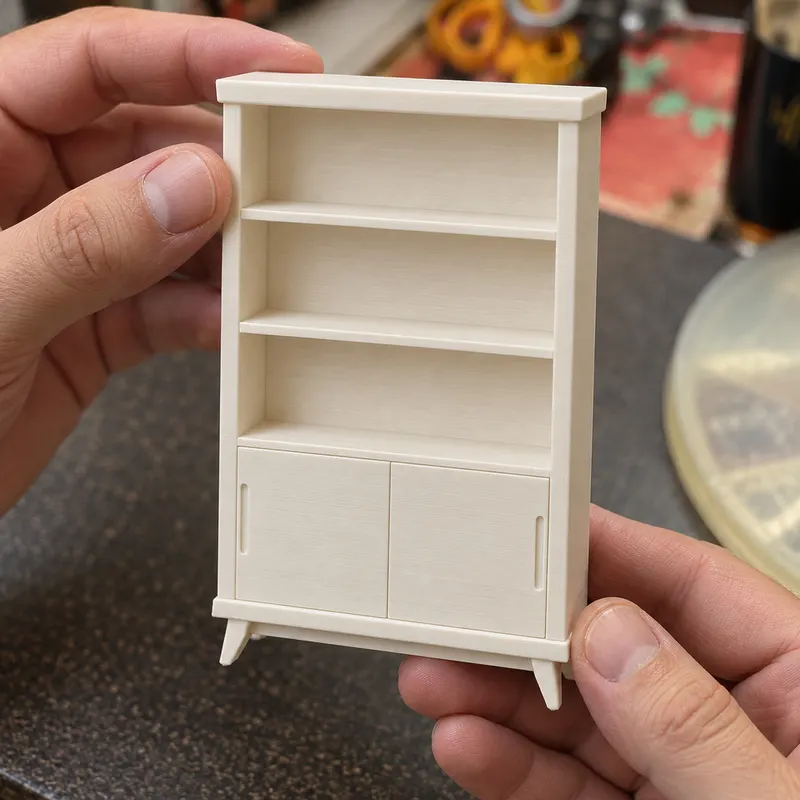
Mid-Century Architectural Library Bookcase
Compare the same bookcase at both supplied scales. Use the height to check its relationship with your ceiling, then compare its footprint with the available floor space.
- 1:12
- 106.5 × 32.5 × 166.7 mm
- 1:24
- 53.2 × 16.2 × 83.3 mm
Dimensions of the supplied files: width × depth × height. Room scenes illustrate the design; they are not physical print test records.
Check this piece’s details and sizes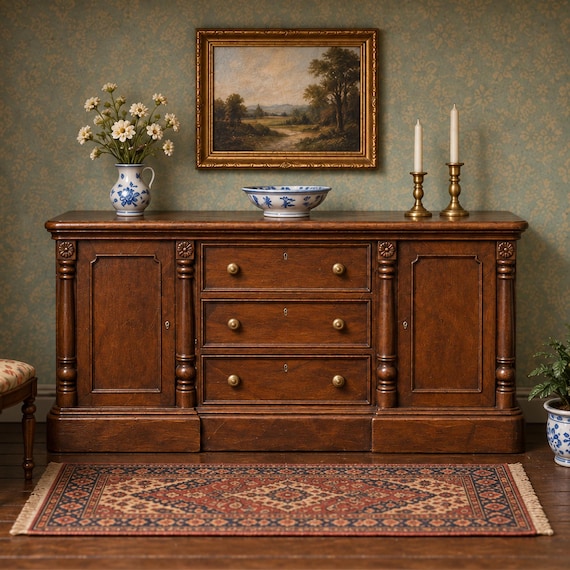
Victorian Dining Sideboard With Central Drawers
A long sideboard shows why width and depth matter independently. Check both measurements even when the scale matches the rest of your room.
- 1:12
- 150.0 × 56.2 × 68.9 mm
- 1:24
- 75.0 × 28.1 × 34.4 mm
Dimensions of the supplied files: width × depth × height. Room scenes illustrate the design; they are not physical print test records.
Check this piece’s details and sizes